Local AI Memory: What Stays on Your Device and What Goes to a Model Provider
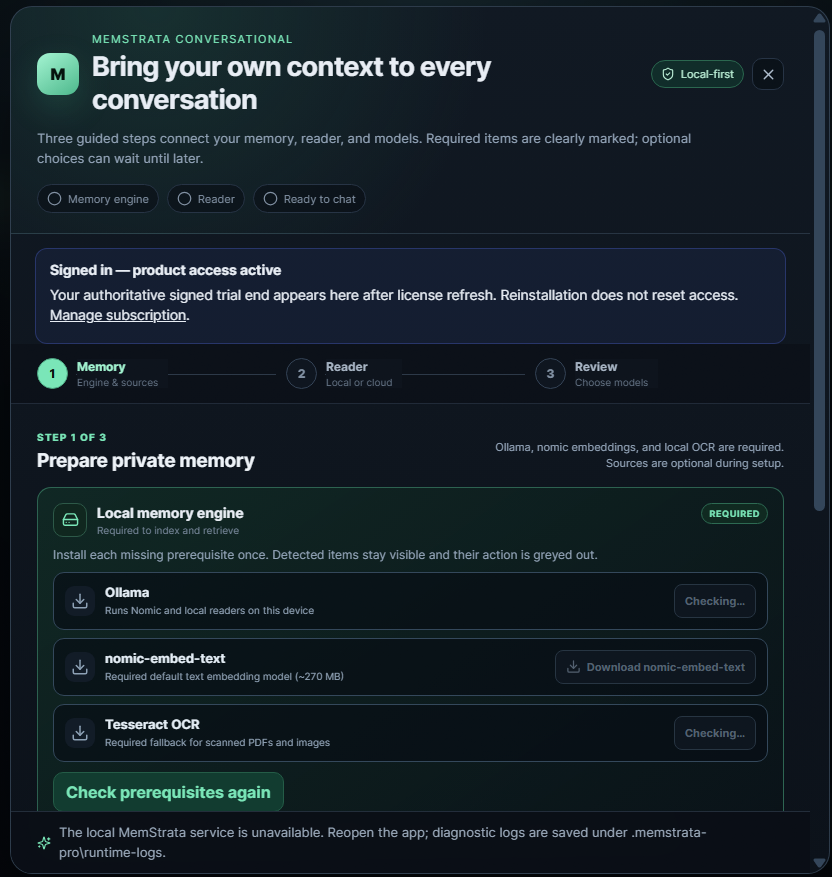
Conversational indexes sources on the device. You connect your own AI. Account and licensing still call MemStrata hosted services. Screenshots are from the historical 0.7.13 walkthrough.
By Neeraj Yadav. MemStrata is built by Neeraj Yadav.
Three paths, three data contracts
Do not treat "local memory" as one switch. Conversational keeps the index on your computer. The AI you connect writes the answer.
- Your AI. A model on your computer does not send the question to a cloud provider. A cloud model receives the question and the selected passages.
- Visual retrieval. Optional ColQwen2 and ColFlor select pages. They are not the answering model.
What stays on the device by default
Imported chats, notes, documents, and local indexes stay on the device. If the model you connect runs on your computer, that inference stays there too. Provider keys sit in the operating-system credential vault.
What can still leave the device
Account, OAuth, entitlements, and device registration send identity and device-bound entitlement fields to MemStrata hosted services. Licensing checks run at startup and refresh. Those calls happen even when the answering model is local.
If you use a context-only host that sends to a cloud model, assume the current question and the selected passages leave the device for that provider. Website analytics on memstrata.dev use Plausible. Details: Trust.
How to check your install
Open Trust if you need the outbound-data table. For a field-level packet list for a specific install, email support@memstrata.dev. This page is the 0.7.x public summary, not a packet capture.
Previous: Why an AI Answer Can Cite a Source and Still Be Wrong Next: Standard versus Deep Evidence: How to Choose the Context Budget